
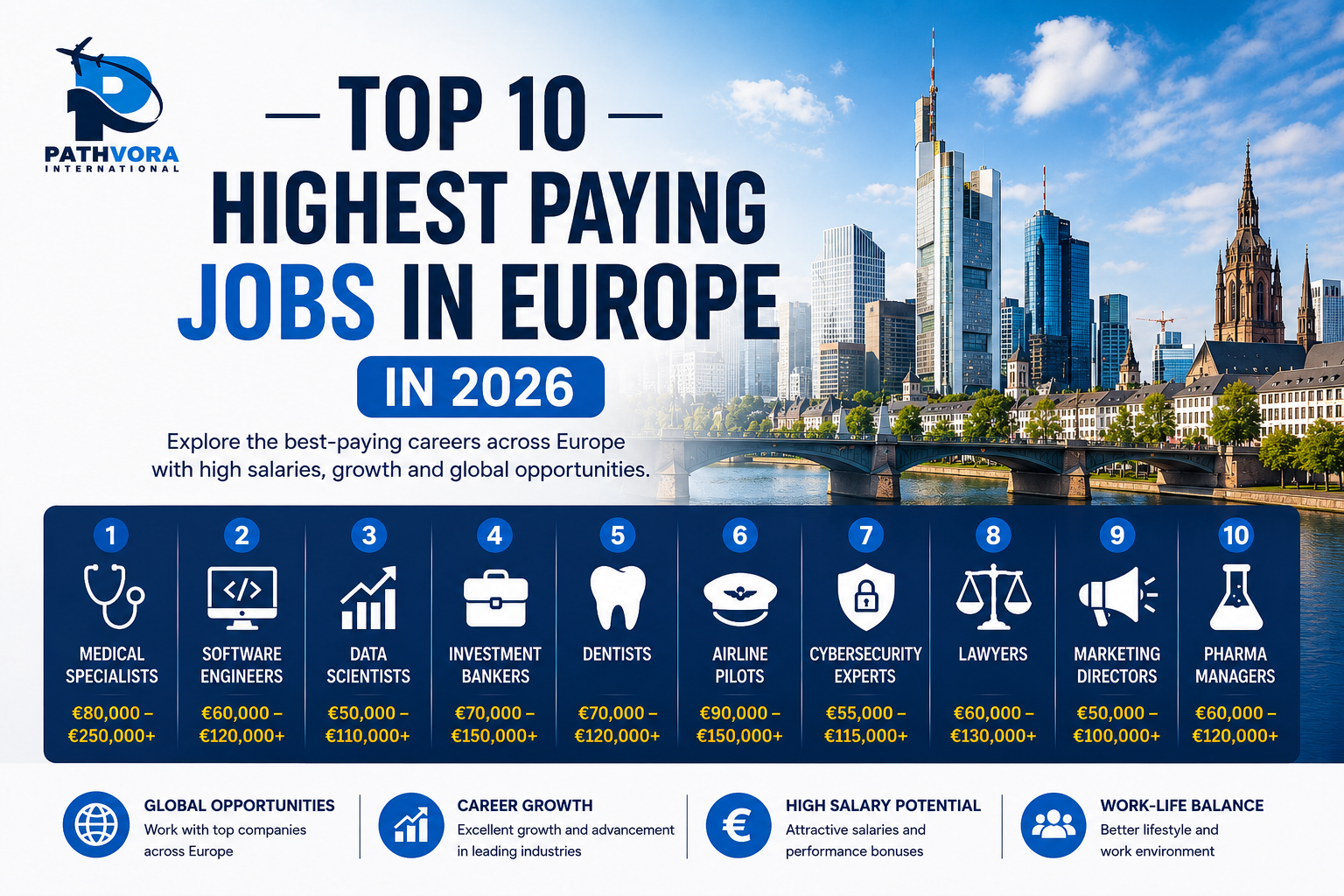
Europe is becoming a popular destination for skilled Indian professionals looking for better career opportunities and higher salaries. Industries such as IT, engineering, finance, and healthcare are seeing strong demand for experienced talent. Countries including Germany, the Netherlands, Italy, and Sweden offer a wide range of job opportunities, particularly for professionals with technical and specialised skills. Depending on the role, experience, and location, professionals can earn around €50,000 to €90,000 annually. For many Indians, moving to Europe is not only about earning more but also about gaining international exposure, improving career prospects, and working in a global environment. With ongoing skill shortages across several industries, Europe continues to be an attractive option for Indians planning to grow their careers abroad.
Highest-Paying Jobs Available Across Europe
Here are some of the highest-paying jobs available across Europe:
| Occupation | Average Annual Salary |
|---|---|
| Software Engineer | €60,000 – €85,000 |
| Data Scientist | €55,000 – €80,000 |
| IT Manager | €70,000 – €95,000 |
| Financial Analyst | €50,000 – €75,000 |
| Mechanical Engineer | €50,000 – €70,000 |
| Electrical Engineer | €52,000 – €72,000 |
| Doctor / Medical Specialist | €70,000 – €120,000 |
| Nurse | €40,000 – €60,000 |
| Cybersecurity Specialist | €60,000 – €90,000 |
| Project Manager | €55,000 – €80,000 |
Why Consider Working in Europe?
- Competitive salaries and strong earning potential
- Better work-life balance and flexible work culture
- Easy travel across many European countries
- Paid annual leave and generous vacation policies
- Opportunity to learn new languages and experience different cultures
- Strong employee benefits and social security
- Safe and comfortable living environment
- Access to quality healthcare and education
Top Careers in Europe
IT Jobs in Europe
Europe’s tech industry is growing fast, creating strong demand for IT professionals. Over 30% of companies in the EU plan to hire more tech workers this year. Skilled professionals in software development, cybersecurity, cloud computing, and AI have excellent opportunities. According to Robert Half, top roles include .NET developers, IT project managers, and IT operations managers. Job growth in Europe’s IT sector is five times higher than in other industries, and salaries continue to rise steadily.
Engineering Jobs in Europe
Engineering professionals are highly sought after across Europe, especially in mechanical, electrical, civil, and chemical fields. Germany leads the continent with huge demand for engineers, thanks to its strong industrial and manufacturing base. Other countries like France, Spain, and the Netherlands also provide attractive job opportunities and competitive pay for skilled engineers.
Healthcare Jobs in Europe
Europe’s healthcare sector offers thousands of openings for doctors, nurses, physiotherapists, and medical technicians. An ageing population and increasing healthcare needs have boosted demand for caregivers, home health aides, and specialists in elderly and rehabilitation care. Countries such as Germany, Ireland, and the Netherlands are actively hiring international healthcare professionals to fill skill gaps.
Finance and Accounting Jobs in Europe
Europe has a strong financial sector that offers rewarding opportunities for accountants, auditors, analysts, and banking professionals. Cities like London, Frankfurt, Zurich, and Luxembourg are major financial hubs offering high salaries and international exposure. With growing demand for professionals skilled in financial planning, risk management, and compliance, Indian finance experts have excellent career prospects in Europe.
Hospitality and Tourism Jobs in Europe
Europe’s tourism and hospitality industry continues to thrive, with openings in hotels, restaurants, travel agencies, and event management. Countries like Spain, Italy, France, and Portugal have a constant need for chefs, hotel managers, front-office staff, and tour guides. This sector offers flexible working options, good earnings, and a chance to work in some of the world’s most popular tourist destinations.
Migrate to Europe with a Work Visa
A European work visa gives eligible international professionals the opportunity to live and work legally in a European country. In most cases, applicants need a confirmed job offer or employment contract from a local employer before starting the visa process. Once approved, the visa allows you to work and stay in the country according to the terms of your permit.
Work visa options differ from one European country to another. Depending on your qualifications, profession, and employment contract, you may be eligible for routes such as the EU Blue Card, Skilled Worker Visa, or other employment permits. These pathways are commonly available for professionals working in areas such as IT, engineering, healthcare, finance, and education.
It’s advisable to begin the application process well ahead of your planned joining date, as processing times can vary depending on the country, application type, and individual circumstances. Visa validity also differs by country and permit, with many work permits allowing you to renew or extend your stay if you continue to meet the required conditions.
Requirements for a Europe Work Visa
Work visa requirements vary across European countries and depend on whether you are an EU or non-EU citizen. EU citizens generally have the right to work in other EU member states without applying for a traditional work visa. Non-EU nationals, however, usually need the appropriate work permit or visa before they can legally take up employment.
While the exact documents can differ by country and visa category, applicants are commonly asked to provide the following:
- Valid passport
- Completed visa application form
- Recent passport-sized photographs
- Valid health or travel insurance
- Proof of accommodation
- Employment contract or job offer from an eligible employer
- Educational and professional qualification documents
- Proof of relevant work experience, where required
- Language proficiency certificate, if applicable
- Medical or health certificate
- Police clearance or other background documents
- Proof of sufficient financial resources, where required
Before applying, it is important to check the specific requirements of the country and work visa category you are applying for, as documentation and eligibility criteria can vary.
Work Visa and Residence Permit
Europe continues to offer strong employment opportunities in sectors such as IT, healthcare, engineering, and construction. Skilled professionals, including software specialists, engineers, doctors, nurses, and other technical workers, are often in demand due to ongoing talent shortages. These sectors can be particularly promising for Indian professionals with relevant qualifications and experience.
For Indian applicants, finding a job in Europe is easier when you focus on industries and roles that are experiencing skill shortages. IT, engineering, healthcare, finance, and construction are among the fields where employers frequently seek qualified international talent. However, work visa and residence permit rules differ from one country to another. Germany, the Netherlands, Luxembourg, and Ireland, for example, have their own eligibility criteria, salary requirements, application procedures, and processing timelines. It is therefore important to check the specific country's requirements before accepting a job or starting your visa application.
Steps to Apply for a Work Visa in Europe
Choose the country where you want to work
Decide which European country best matches your career goals, job profile, and eligibility.
Check the visa and work requirements
Review the country’s eligibility criteria, salary requirements, qualifications, and work permit rules.
Search and apply for suitable jobs
Look for vacancies through company websites, trusted job portals, recruitment agencies, and professional networks.
Secure a job offer
Once you are selected, obtain a formal job offer or employment contract from your prospective employer.
Prepare your documents
Keep your passport, employment contract, educational certificates, photographs, insurance, and other required documents ready.
Submit your visa application
Apply through the relevant embassy, consulate, visa centre, or official online portal, depending on the country.
Attend an interview or biometric appointment
If required, complete your biometrics and attend a visa interview as part of the application process.
Wait for the decision
Visa processing times vary by country and visa type, so allow sufficient time for your application to be reviewed.
Travel and complete local formalities
After your visa is approved, travel to your destination country, complete any required residence registration or permit formalities, and begin your employment legally.
Europe Work Permit
Work permit requirements vary from country to country and depend on your citizenship and employment type. EU citizens can generally work in other EU countries without needing a traditional work visa. Non-EU professionals, including Indian applicants, usually need a valid work permit or visa before starting employment. The process typically requires a job offer, relevant qualifications, and supporting documents.
Types of Work Permits in Europe
Non-EU citizens generally need the right work permit to live and work legally in Europe. The type of permit you need depends on factors such as the country, nature of your job, length of stay, and professional background. Some of the common work permit categories include:
- Temporary Work Permit: Suitable for short-term employment, seasonal contracts, or fixed-duration jobs.
- Permanent Work Permit: Designed for eligible foreign workers who have lived and worked in a European country for a longer period and wish to continue their stay.
- Seasonal Work Permit: Commonly used for temporary jobs in agriculture, tourism, hospitality, and other seasonal industries.
- Intra-Company Transfer Permit: For employees who are transferred by their international employer to a branch or office in another European country.
- Freelance or Self-Employment Permit: For professionals planning to work independently, offer services, or operate their own business.
- Research or Academic Work Permit: Available for eligible researchers, scientists, academics, and teaching professionals working with recognised institutions.
EU Blue Card
The EU Blue Card is designed for highly qualified professionals from outside the EU who want to live and work in participating European countries. It can offer several benefits, including easier mobility within the EU, family reunification, and a pathway towards long-term or permanent residence, depending on the country’s rules.
To qualify, applicants generally need a recognised higher-education qualification or relevant professional experience, a valid job offer or employment contract, and a salary that meets the required threshold. The EU Blue Card is currently available in 25 EU countries, while Denmark and Ireland are not part of the scheme.
The card can generally be issued for the length of the employment contract, up to a maximum of four years. After 12 months of legal residence in the first EU country, Blue Card holders can also move to another participating EU country under simplified mobility rules, subject to the applicable conditions.
Ready to Launch Your Career in Europe?
Pathvora International provides end-to-end support for Indian professionals, from resume marketing to official visa filing assistance.
Book Free Career Counselling ➔How Can Pathvora Assist You?
Pathvora helps you take the right steps towards building a career in Europe. Our services include:
- Expert Career Guidance & Counselling: Strategic advice on European labor markets and visa pathways.
- Resume Marketing Services: Helping connect your profile with suitable European job opportunities.
- Professional Profile Optimization: Resume Writing, Job Marketing, LinkedIn Marketing, and Resume Promotion.
- Guidance with Job Applications: Helping you prepare and submit high-conversion applications.
- Language & Career Coaching: Support with IELTS, TOEFL, German language, and other relevant preparation.
- End-to-End Career Support: From profile building and job search to guidance throughout your Europe career journey.
- Free Career Counselling: Book a session with our experts and take the first step towards your global career.
FAQ OF THE BLOGS
1. What are the highest paying jobs in Europe in 2026?
The highest paying jobs in Europe in 2026 include specialist doctors, AI and IT professionals, software engineers, data scientists, finance professionals, engineering managers, and senior skilled professionals. Salaries vary by country, qualifications, experience, and industry.
2. Which European country has the highest salaries?
Switzerland and Luxembourg are among Europe's highest-paying locations, while countries such as Germany, Denmark, the Netherlands, Norway, and Ireland also offer attractive salaries for skilled professionals. Actual earnings depend on occupation, experience, taxes, and cost of living.
3. How can I get a high-paying job in Europe in 2026?
To get a high-paying job in Europe, identify occupations matching your qualifications and experience, research countries where your skills are in demand, prepare a European-standard CV, apply for suitable positions, and check the relevant Europe work visa and work permit requirements.
4. What qualifications are required for high-paying jobs in Europe?
Requirements depend on the profession and country. Generally, candidates may need relevant education, professional experience, technical skills, language proficiency, qualification recognition, and an appropriate work visa or work permit.